
Spiritual alignment is one of those phrases that can sound beautiful and still leave you wondering what it means on a Tuesday afternoon. It does not have to mean that every part of life feels easy, that you have found one perfect path, or that you no longer have difficult feelings. More often, alignment is the felt sense that your inner knowing and your outer choices are beginning to move in the same direction.
You may recognize it as a little less inner negotiation. A decision lands without the usual knot in your stomach. A relationship, responsibility, or routine begins to feel more honest. You stop spending quite so much energy trying to convince yourself that something is fine when it is not. The change can be quiet. It can be a willingness to tell the truth, slow down, ask for support, or let an old role become too small for you.
For Dr. Asia Taylor, alignment is not a performance of spirituality. It is a practice of coming home to your own signal, then choosing a life that can hold it. The Coherence Blueprint™ is built around that deeper work: noticing the gap between who you are becoming and the structures, patterns, and expectations that have not caught up yet.
What spiritual alignment means
Spiritual alignment can mean different things across faiths, traditions, and personal practices. For some people, it is a closer relationship with God, prayer, or a sense of sacred purpose. For others, it is living in better relationship with intuition, nature, ancestry, community, or the values they want their life to express. There is no single vocabulary you have to adopt for the experience to be real.
A useful, grounded definition is this: spiritual alignment is when your attention, values, body, relationships, and actions are in enough agreement that you can recognize yourself in the life you are living. It is not certainty. It is not a guarantee that every choice will work out. It is a return to congruence, the relief of not abandoning what you know matters to you.
That is why alignment often becomes important during change. A career may no longer fit. A relationship may ask for a truer conversation. Grief may rearrange what feels meaningful. The old ways of staying safe or pleasing everyone may stop working. None of that proves you are broken or behind. It may simply mean that something in you needs a more honest place at the table.

What alignment is not
Alignment is not a mood you have to maintain. You can be grieving, uncertain, tired, angry, or afraid and still be deeply aligned with yourself. In fact, sometimes alignment begins when you stop treating those feelings as inconveniences and start listening for the information inside them.
It is also not a pass for avoiding real-world responsibilities. A spiritual practice that helps you notice your truth should make you more capable of honest choices, clear boundaries, repair, and care for your life, not less. You still get to make the call, have the conversation, rest, apologize, ask for help, or take the next practical step.
And alignment is not evidence that you should ignore medical, mental-health, legal, or financial support. Spiritual reflection can sit alongside those forms of care. It is not a substitute for them. If stress, anxiety, low mood, or distress is interfering with daily life or getting worse, the <a href="https://www.nimh.nih.gov/health/publications/my-mental-health-do-i-need-help" target="_blank" rel="noopener noreferrer">National Institute of Mental Health recommends talking with a health care provider</a>. If you are in immediate danger in the United States, call or text 988, or call 911.
Signs you may be feeling out of alignment
Misalignment is not always dramatic. It can feel like performing a version of yourself that once made sense but no longer does. You may keep saying yes when your body is quietly asking for space. You may move through a full week and realize you have not had one moment to hear your own thoughts. You may feel stretched between what you know and what you are willing to admit.
Look for patterns, not proof. Do certain conversations leave you more distant from yourself? Does one part of your life require a level of self-erasure that another part does not? Are you making decisions from urgency, approval, fear, habit, or actual desire? These are not questions to use against yourself. They are places to become curious.
You might also notice the opposite: small moments that bring you back. A walk without your phone. A conversation where you do not have to translate yourself. A practice that leaves you more spacious instead of more pressured. A clear no. A simple ritual. Alignment is often easier to recognize by contrast.

A five-step practice for returning to alignment
You do not need to solve your whole life in one sitting. Try this short check-in when you feel pulled in too many directions.
First, pause long enough to notice what is happening. Put both feet on the floor, look around the room, and let your attention land somewhere steady. The goal is not to create a perfect meditation. It is to interrupt the habit of making every decision from a rush.
Second, name the tension plainly. Finish the sentence: “Part of me wants ___, and part of me is afraid of ___.” Let both sides exist without trying to force a winner. Clear language can soften the fog around a decision.
Third, ask what value is asking to be honored. It could be rest, truth, devotion, creativity, stability, reciprocity, privacy, service, or freedom. Choose one word, not a grand identity statement. A value becomes useful when it can guide one actual choice.
Fourth, make the next step small enough to keep. Send the honest message. Take the walk. Move one appointment. Open the journal. Say no without a long defense. Ask for the information you need. Alignment grows through choices your real life can support, not through promises made while you are exhausted.
Finally, notice how the step feels afterward. You may not feel immediate peace. Instead, look for a little more room, clarity, or self-respect. Keep what creates that feeling. Adjust what does not. This is discernment, not a test.
Use your body as part of the conversation
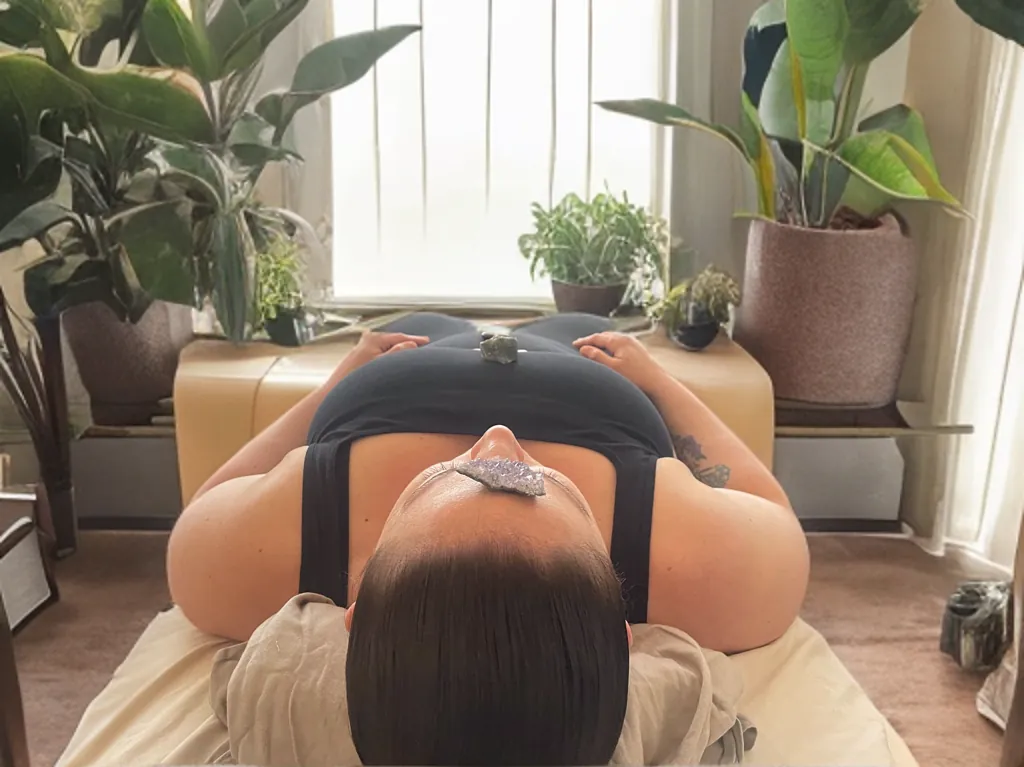
Spiritual alignment is not only an idea. Your body is often the first place to register when a pace, expectation, or decision is costing too much. That does not mean every sensation is a message you must decode, or that anxiety is intuition. It means your body deserves to be included in the conversation rather than overruled by it.
Before you make a choice, create a little more room to notice. A short pause, water, fresh air, a slower exhale, or a few minutes of quiet can help. Dr. Asia’s nervous system reset guide offers a gentle place to begin when everything feels like too much. It is not about forcing calm. It is about making the next honest choice more available.
Choice matters here. A practice is only supportive when you can adjust it, stop it, or leave it. That is why safety, trust, collaboration, and empowerment are central principles in SAMHSA’s trauma-informed approach. Your spiritual practice should not ask you to override your own no.
Let alignment be relational, not solitary
It is easy to think alignment is something you find alone in a quiet room. Solitude can be valuable, but relationships reveal important truths too. The people who make it safe to speak plainly, change your mind, or have a boundary can help you hear yourself more clearly. The relationships that repeatedly require you to disappear can offer information as well.
You do not need to make every relationship decision immediately. Start by asking where you feel most able to be honest. Notice where your care is reciprocal, where you are over-functioning, and where a clearer request might create more space. Alignment is not isolation. It is a more truthful way of being with yourself and other people.
A deeper container for a season of change
Sometimes a short check-in is enough to help you make the next choice. Other times, you are in a season where an old identity, rhythm, or relationship to yourself has ended, and you need more space to understand what is emerging. That is not a problem to solve quickly. It can be a threshold that benefits from care, reflection, and a steady container.
The Coherence Blueprint™ is Dr. Asia’s deeper process for women navigating that kind of transition. It brings together intuitive insight, Human Design, frequency work, and grounded reflection to help you recognize the pattern beneath the static and build a life that can meet the person you are becoming. If a focused sound-based reset feels like the right first step, her Tuning Fork Alignment Session offers a private, paced space for presence and recalibration.
Alignment is a return, not a finish line
You will lose the thread sometimes. Everyone does. The work is not to become permanently certain, perfectly peaceful, or beyond the messiness of being human. The work is to notice sooner when you have moved away from yourself, then return with more kindness and less performance.
Start with what is true today. Let one choice become more honest. Let one practice become more supportive. Let one conversation make more room for your real voice. That is often what spiritual alignment looks like in a living, breathing life.
Frequently asked questions
What does spiritual alignment mean?
Spiritual alignment is the felt sense that your values, inner knowing, relationships, and everyday choices are moving in a more honest direction. It can look different across faiths and traditions, and it does not require perfect certainty or constant calm.
How do I know if I am out of alignment?
You may feel pulled between what you know and what you are doing, chronically overextended, distant from your own needs, or stuck in a role that no longer fits. Treat these as invitations to get curious, not as proof that you have failed.
Can I get back into alignment quickly?
A short pause can help you reconnect with what matters, but alignment is usually built through small repeatable choices. Name the tension, identify one value you want to honor, and take one next step that your real life can support.
Is spiritual alignment the same as mental-health care?
No. Spiritual reflection can be a meaningful wellness practice, but it is not medical or mental-health treatment. If distress is persistent, worsening, or interfering with daily life, reach out to a qualified health or mental-health professional.


