

When life feels loud, spiritual grounding is not about becoming perfectly calm or finding the right answer on command. It is the quieter work of returning to what is here: your body, your breath, the room around you, and the values that matter when you are not trying to outrun yourself. You do not need a complicated ritual to begin. You need a practice that makes it easier to hear your own life again.
People often look for grounding during change, after a hard conversation, in a season of grief, when too many decisions are asking for attention, or when spiritual practice has started to feel like another performance. The point is not to escape those experiences. It is to meet them with enough steadiness that you can choose your next step without abandoning yourself.
If the language of grounding feels familiar but vague, it helps to begin with spiritual alignment. Alignment is the larger direction, while grounding is one way to come back to yourself before you decide what direction to take.
What it means to be spiritually grounded
Being spiritually grounded does not mean you never feel anxious, emotional, intuitive, uncertain, or moved by a meaningful experience. It means you can stay in relationship with your actual life while those feelings are present. You can feel what you feel and still eat lunch, return a message, make a boundary, rest, ask for help, or change your mind.
A grounded spiritual practice makes room for reality. It does not ask you to pretend that every difficult feeling is a sign, that every delay is a failure, or that you must decode your entire future before taking one kind next step. Often, the most spiritual thing you can do is notice what is true now and respond without adding more pressure.
Grounding can look different across faiths, cultures, and personal practices. Prayer, time outdoors, movement, singing, journaling, cooking, tending a garden, or sitting with a trusted person can all be forms of return. The practice is not valuable because it looks mystical from the outside. It is valuable when it helps you feel more present, more honest, and more able to care for your life.

Start with the room you are in
Before you ask a big spiritual question, give your attention somewhere simple to land. Look around slowly and name five ordinary things you can see. Notice the shape of a window, the color of a wall, the edge of a table, or the light on the floor. Keep your eyes open if that helps you feel more oriented. There is no prize for making a grounding practice more intense than it needs to be.
Then notice what is supporting you. Feel your feet in your shoes or on the floor. Feel the chair under your legs, the fabric against your skin, or the weight of your hands in your lap. You do not have to force a deep breath. Let your breath be ordinary. The aim is to give your nervous system evidence that you are here, in this room, in this moment.
For days when everything feels like too much, Dr. Asia’s five-minute nervous system reset offers another simple sequence for orienting, noticing, and choosing a manageable next action. Grounding is allowed to be practical.
Step 1: Name what is happening without making it a verdict
Try one plain sentence: “I feel scattered.” “I am bracing for this conversation.” “I want to disappear for a while.” “I am excited and afraid.” Naming your experience is different from deciding what it means. It helps create a little space between the feeling and the story you may be telling about yourself for having it.
Keep the language kind and specific. Instead of saying, “I am a mess,” try, “I have had too much input today.” Instead of, “I should know what to do,” try, “I do not know yet, and I can give myself ten minutes before I decide.” This is not positive thinking. It is accurate thinking with less cruelty folded into it.
You may also find it helpful to name what is not required right now. You do not have to solve the whole relationship, choose the whole career, explain your whole past, or turn a difficult afternoon into a personal breakthrough. One true sentence is enough to begin.
Step 2: Come back to one physical anchor
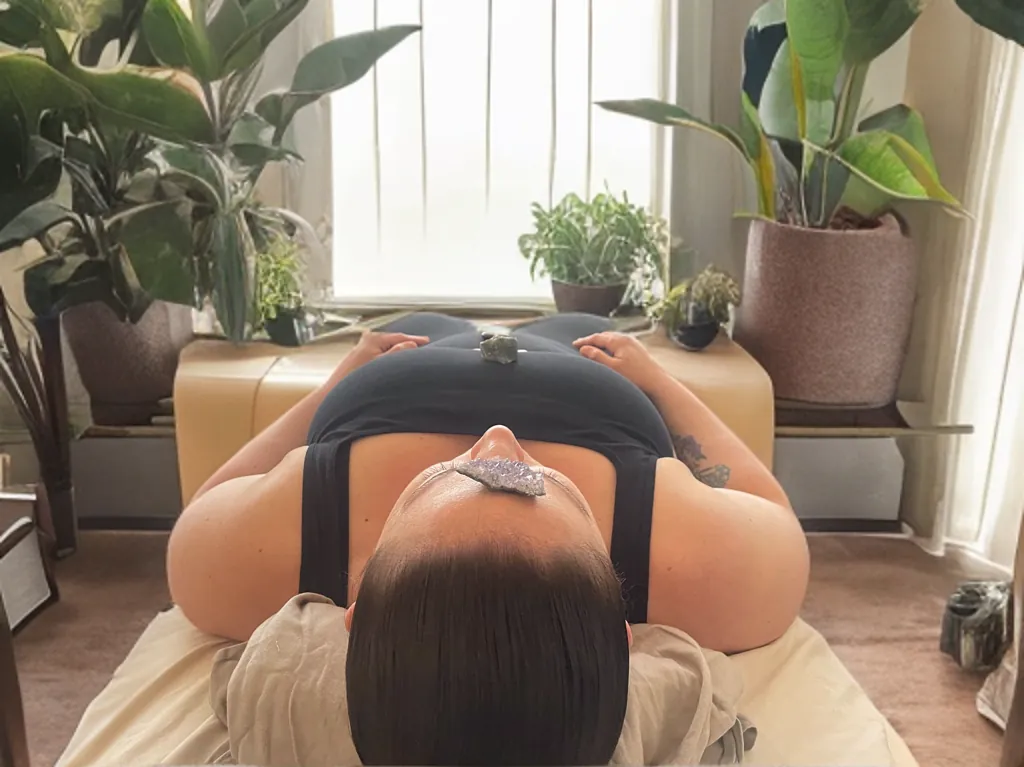
Choose an anchor you can actually feel. Press both feet into the floor. Hold a cool glass of water. Place one hand over your heart and the other on your thigh. Walk to the end of the block and notice the air. Take a shower and feel the water on your shoulders. The best anchor is not the most impressive one. It is the one you can return to without negotiating with yourself.
If you use sound as part of your practice, keep it gentle and optional. A quiet tone, soft music, humming, or a few minutes of silence may help you settle into your senses. If sound feels sharp, tiring, or emotionally overwhelming, stop and choose a different anchor. Your body does not need to prove its openness by pushing through discomfort.
That comfort-first approach also guides Dr. Asia’s Tuning Fork Alignment Session. A private session can be a place to slow down and receive support, but it should always leave room for your choices, your pace, and your no.
Step 3: Ask what needs care, not what needs fixing
Once you have a little more space, ask a softer question: “What needs care right now?” The answer might be water, food, sleep, a clearer boundary, a shower, a walk, a canceled plan, an honest message, or ten minutes without a screen. It might be grief. It might be a conversation you have been postponing. It might be the permission to do less.
This question is useful because it moves you away from self-improvement urgency. You are not a project that must be repaired before you deserve peace. You are a person living through a real day. Care may be small and ordinary, but ordinary care can restore enough capacity to help you hear what matters.
If reflection is part of the answer, use one of Dr. Asia’s guided meditations as a container rather than a test. You do not need to have a profound experience. You only need a few minutes where you are not demanding an answer from yourself.

Step 4: Choose one value to stand on
When you feel ungrounded, your values can be steadier than your mood. Choose one word that matters today: honesty, rest, courage, reciprocity, creativity, devotion, spaciousness, safety, or freedom. Then let that word guide one small choice. If rest is the value, perhaps you move a nonessential task. If honesty is the value, perhaps you write the first line of the message you have been avoiding.
The goal is not to create a new identity around a single word. The goal is to have something solid enough to stand on while the rest of life feels less clear. Values make grounding active. They help turn an inner pause into a choice that your future self can recognize.
This is where grounding begins to meet the deeper work of the Coherence Blueprint™. You may be changing faster on the inside than your routines, relationships, or expectations can keep up with. A value-led choice can help close that gap without forcing the whole transformation to happen overnight.
Step 5: Close the practice and re-enter your day
Grounding is not meant to remove you from life forever. Close with something concrete. Drink water. Open the blinds. Wash one dish. Put your shoes on. Send the short message. Write down the next appointment. Step outside for two minutes. A physical ending tells your mind and body that the pause has a place in the day, and that you can return to your responsibilities without abandoning the part of you that needed attention.
Notice what changed, but do not demand a dramatic result. You may feel calmer, clearer, sadder, more tired, or exactly the same. All of that is information. A grounding practice has done enough when it helps you meet the next moment with a little more choice and a little less self-betrayal.
When grounding needs more support
Spiritual grounding can be a meaningful wellness practice, but it is not medical or mental-health care. If distress is persistent, getting worse, interfering with daily life, or leaving you unable to care for yourself, reach out to a qualified health or mental-health professional. The National Institute of Mental Health offers guidance on when to seek professional help. If you are in immediate danger in the United States, call or text 988, or call 911.
Choice matters in every supportive practice. The principles of SAMHSA’s trauma-informed approach include safety, trust, collaboration, empowerment, and voice. If a practice makes you feel pressured to override your limits, it is okay to pause, adapt it, or choose something else.
Let grounding be a return, not another rule
You do not need to be grounded all the time. You do not need the perfect ritual, the perfect words, or a perfectly quiet mind. You only need a way back when you notice you have gone too far from yourself. Start with the room. Name what is true. Feel one anchor. Offer yourself one practical kindness. Choose one value-led next step.
If you are in a season that needs more than a brief reset, explore Dr. Asia’s private sound and vibrational sessions or begin with a Clarity Call. The right support should help you hear yourself more clearly, not hand you a louder set of rules.
Frequently asked questions
What does it mean to ground yourself spiritually?
Spiritual grounding means returning to your body, your present surroundings, and the values that help you make a true next choice. It is not about avoiding emotion or becoming perfectly calm. It is about staying connected to real life while you move through what you feel.
How can I ground myself quickly?
Start by looking around the room, feeling your feet on the floor, and naming one true sentence about what is happening. Then choose one physical anchor, such as a glass of water, a short walk, or the support of a chair. A brief practice can create enough space for the next manageable step.
Can spiritual grounding help when I feel overwhelmed?
A gentle grounding practice may help you orient to the present moment and decide what kind of care you need next. It is not a replacement for medical or mental-health support. If overwhelm is persistent, worsening, or interfering with daily life, reach out to a qualified professional.
Do I need a ritual or special tools to ground spiritually?
No. Rituals and tools can be meaningful when they support you, but they are not required. Your senses, a chair, water, fresh air, a journal, and one honest value can be enough to begin.