
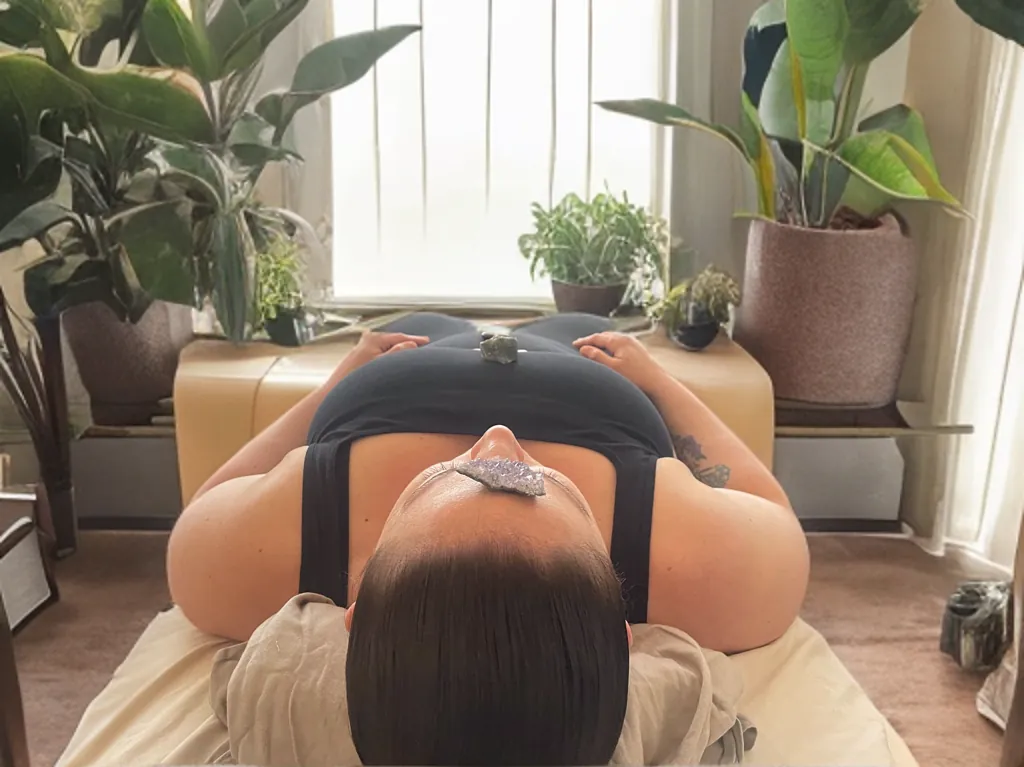
Somatic grounding exercises are small, body-based ways to return to the present when your attention has gone racing ahead, circling the past, or scattering in every direction at once. They do not ask you to solve the whole situation. They offer a place to begin: the support under your body, a sound in the room, cool water in your hand, or the simple fact that you can choose one thing at a time.
The word somatic simply means relating to the lived experience of the body. In a grounding practice, that can be wonderfully ordinary. You might notice your feet in your shoes, the weight of your hands, the edge of a chair, or the temperature of the air. The practice is not about becoming perfectly calm, spiritually impressive, or detached from what is hard. It is about creating enough room to meet the next moment with a little more choice.
This is closely related to spiritual alignment, but it starts closer to the ground. Alignment asks whether your inner knowing and outer choices are moving together. Somatic grounding gives you a way to pause before you decide what that knowing is asking of you.
What somatic grounding can and cannot do
A short practice can help you notice what is happening now. It may make a difficult conversation feel less consuming, help you transition after a busy day, or interrupt the urge to force an answer before you are ready. It may also reveal that you are tired, hungry, grieving, overstimulated, or in need of more support than a five-minute reset can offer. That information is useful.
Grounding is not medical treatment, a diagnosis, or a promise to make distress disappear. It is a gentle wellness practice. If a sensation, memory, or emotion grows more intense when you turn your attention inward, it is okay to stop. Open your eyes, look around the room, move to a more comfortable place, contact someone you trust, or choose a more external form of support. Your body does not need to prove anything by pushing through.
The same respect for choice appears in the Substance Abuse and Mental Health Services Administration's trauma-informed care principles, which emphasize safety, trust, collaboration, empowerment, and voice. You do not need to use a particular method because it works for someone else. Keep the practices that feel supportive, and leave the rest.

1. Let your eyes find five ordinary things
Start with the room, not the story in your head. Slowly look around and name five neutral things you can see: the corner of a window, a lamp, a green leaf, the pattern on a rug, or the handle of a mug. Let your eyes move at a pace that feels comfortable. You are not hunting for a special feeling. You are reminding your attention that this room is here.
Then add a little detail. Notice which object is closest, which is farthest away, where the light is coming from, and which colors repeat. If counting feels irritating, skip it. You can simply let your gaze rest on something that feels steady or pleasant enough. An open-eyed practice can be a better entry point than closing your eyes when you feel overloaded or unreal.
Try this before responding to a message that has activated you, when you arrive home after a demanding day, or while sitting in the car before you drive. It is not an avoidance tactic. It is a brief way to give your attention a landing place before you ask it to make a decision.
2. Feel one point of support
Choose one place where your body is already supported. Feel your feet against the floor, your back against a chair, your hands against your thighs, or your shoulders against a wall. Press very lightly if pressure feels good. If it does not, simply notice the contact that is already there. The point is not to force your body to relax. It is to recognize that something is holding you up right now.
You can pair the contact with a plain sentence: “The floor is here.” “This chair is holding me.” “I can feel my hands.” Keep the language simple enough that your system does not have to work to understand it. If breath-focused exercises make you uncomfortable, you do not have to add breathing at all. Physical support, an open gaze, or a small shift in posture can be enough.
For a short sequence that builds on this kind of orientation, visit Dr. Asia's five-minute nervous system reset guide. It offers a practical rhythm for noticing support, naming what is present, and choosing one manageable next action.

3. Use temperature or texture as an anchor
A sensory anchor gives your attention something specific to meet. Hold a cool glass of water. Wrap your hands around a warm mug. Run your fingers across a sweater sleeve, a smooth stone, a blanket, or the ridged edge of a key. Notice only a few qualities: cool or warm, soft or rough, heavy or light, still or moving.
This can be especially useful when words feel like too much. You do not need to understand why you are unsettled before offering yourself a concrete point of contact. Let the object be ordinary. A grounding practice does not become more valid because it looks ceremonial from the outside. The best anchor is often the one that is already within reach.
If you are at work or in public, try pressing your fingertips together beneath the table, feeling the fabric of your sleeve, or holding a cup while you notice its temperature. These are quiet choices that do not require a special room, tool, or explanation.
4. Move in a way that gives you more room
Stillness is not the only route back to yourself. Sometimes the most supportive thing is to stand up, stretch your arms, walk slowly to the next room, roll your shoulders, shake out your hands, or step outside for two minutes. Choose movement that feels non-demanding. You are not trying to burn off a feeling or perform a workout. You are giving your body a chance to complete one small, intentional action.
Try a simple pattern: plant both feet, look at the room, and take ten slow steps while noticing the change in pressure under each foot. When you reach the end of the room, pause. Ask whether you need more movement, less movement, water, food, rest, or a conversation. The answer may be very modest. Modest is good. A practice that fits into your actual day is more likely to become a resource you can return to.
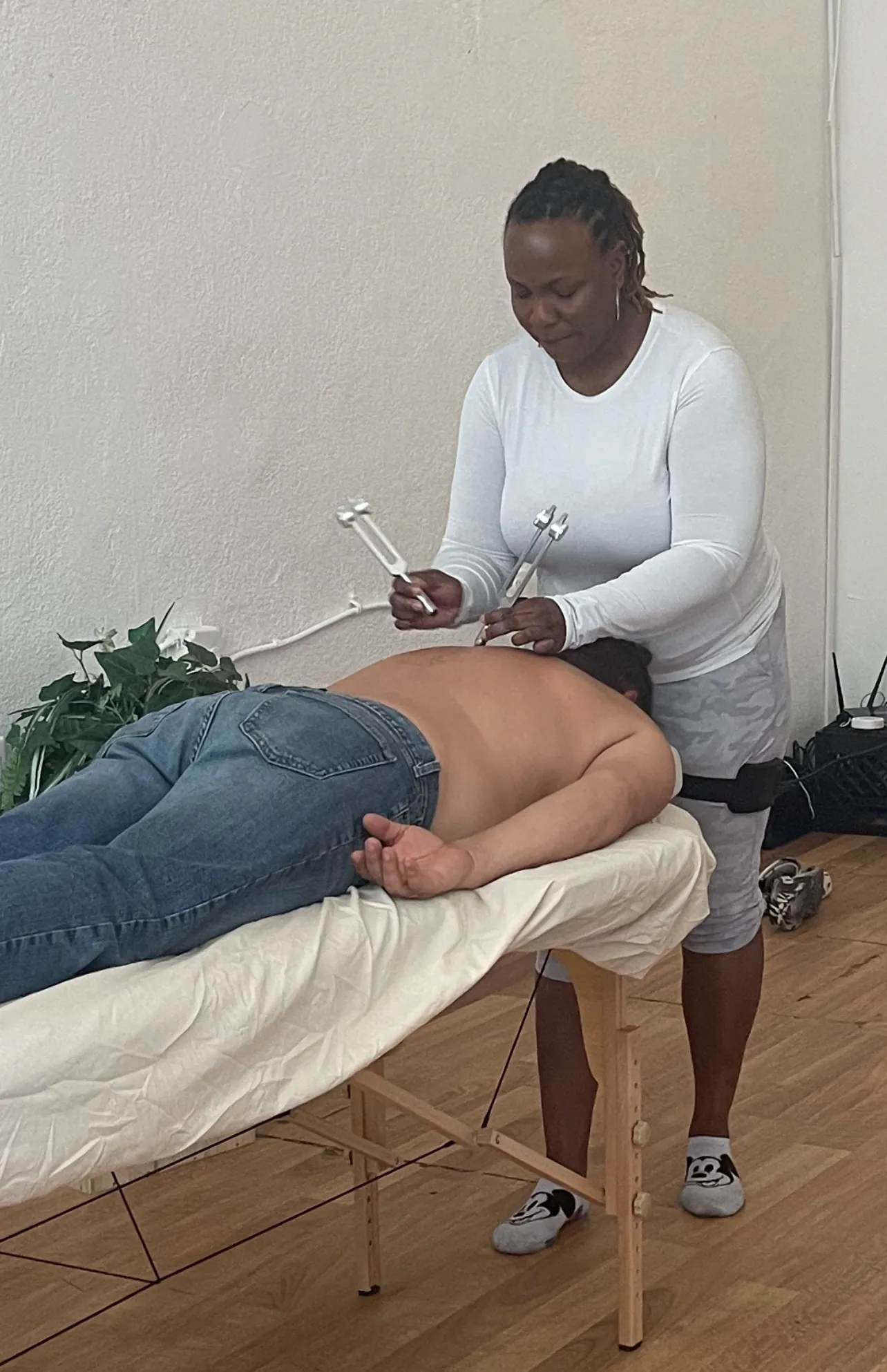
If you want a private setting for a slower, sound-based reset, Dr. Asia's Tuning Fork Alignment session is paced around comfort, intention, and choice. It is spiritual and wellness support, not a replacement for clinical care.
5. Ask one body-friendly question
Once you have a little more contact with the present, ask a question that does not demand a grand answer. Try: “What would make the next ten minutes gentler?” “What feels like too much right now?” “What is one thing I can postpone?” “What do I need before I decide?” Or simply: “What is true in this moment?”
Notice the difference between a question that invites care and one that turns you into a problem to solve. “Why am I like this?” usually tightens the room. “What would support me?” creates a little more space. You might write one line in a journal, send a short honest message, eat something, close a browser tab, or let a decision wait until tomorrow.
This kind of pause is part of the work behind The Coherence Blueprint™: giving your inner shifts enough room to become practical choices. Coherence is not a life without uncertainty. It is a life where your values, needs, and next steps have a better chance to recognize one another.
A simple five-minute somatic grounding practice
If you want a repeatable sequence, begin with one minute of looking around the room. In minute two, feel the support beneath your body. In minute three, hold something with a clear temperature or texture. In minute four, take a few slow steps or gently change position. In minute five, choose one kind, concrete next action. You may not feel transformed. You do not need to. The aim is to be a little more present for your own life.
Keep the sequence flexible. On some days, the room may be too busy, movement may be unwelcome, or a warm drink may be the only step that feels available. Adaptation is not failure. It is part of listening. A practice that honors your limits is more likely to build trust with yourself than one you have to force.
When a grounding exercise is not enough
A grounding exercise can be one caring tool, but it cannot carry everything. If distress is persistent, worsening, interfering with your daily life, or leaving you concerned for your safety, reach out to a qualified health or mental-health professional. The National Institute of Mental Health shares signs that it may be time to seek professional help. In the United States, call or text 988 for immediate crisis support, or call 911 in an emergency.
Let the return be small and real
Somatic grounding is not about becoming someone who is never overwhelmed, uncertain, sad, or affected by the world. It is a way to meet those moments without leaving yourself behind. Look around. Feel one point of support. Touch something real. Move if movement helps. Ask one gentle question. Then choose the next small thing your life can hold.
When you are ready for deeper reflection around change, identity, or a life that no longer fits, explore Dr. Asia's private sessions or begin with a Clarity Call. The goal is not to hand you a louder set of rules. It is to help you hear your own next true step.
Frequently asked questions
What are somatic grounding exercises?
Somatic grounding exercises are simple practices that use sensation, movement, and awareness of your surroundings to help you return to the present. They can include noticing your feet on the floor, looking around the room, holding a warm or cool object, or taking a few slow steps.
Can I do somatic grounding exercises anywhere?
Many grounding practices can be adapted for ordinary places such as your desk, car, kitchen, or a waiting room. You can look for a few neutral objects, feel the contact of your hands or feet, notice the texture of your clothing, or hold a cup of water. Choose what feels comfortable and appropriate for the setting.
What if focusing on my body makes me feel worse?
You do not need to push through. Shift attention outward by looking around the room, listening for ordinary sounds, or contacting someone you trust. If distress is persistent, escalating, or affecting your ability to function, reach out to a qualified health or mental-health professional.
Are somatic grounding exercises a replacement for therapy?
No. Somatic grounding exercises are gentle wellness practices that may help you pause and notice what support you need. They are not medical or mental-health treatment, diagnosis, or a replacement for professional care.